
Navajo Sandstone: The Rock Behind the Colors
Antelope Canyon is carved entirely from Navajo Sandstone, a sedimentary rock that was formed roughly 190 million years ago during the Jurassic period. At that time, a vast desert covered much of what is now the American Southwest. Wind piled enormous sand dunes layer upon layer, and over millions of years, those dunes were buried, compressed, and cemented together by minerals — primarily iron oxide and calcium carbonate — to create the rock we see today.
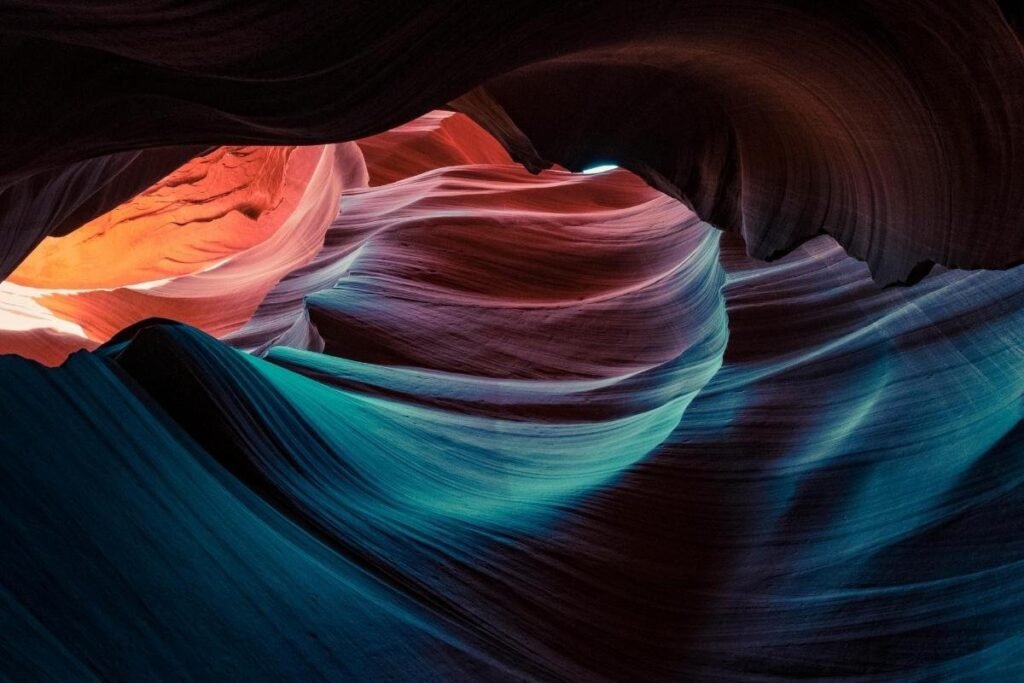
That iron oxide is the reason the walls glow orange, red, pink, and purple depending on the time of day and the angle of sunlight filtering down from above. The colors are not painted on or a trick of photography. They are baked into the stone itself, and they shift dramatically as the sun moves across the sky. If you visit around midday in the summer months, shafts of light drop straight down into the narrow corridors and create the beam effect that photographers travel from around the world to capture. If you prefer a longer window for shooting, the Antelope Canyon Night Photography Tour offers a completely different perspective, letting you work the canyon after the crowds have cleared and the light turns golden at the entrance.
Navajo Sandstone is relatively soft compared to harder rocks like granite or quartzite, which is exactly why water has been able to sculpt it into such dramatic shapes. The formation spans a huge area across Utah and Arizona, and Antelope Canyon sits within the Navajo Nation near Page, Arizona — one of the most concentrated and visually stunning exposures of the rock anywhere on the Colorado Plateau.
How Water Turned Stone Into Art
Understanding the rock type is only half the story. The real question is how Navajo Sandstone became these smooth, swirling slot canyons in the first place. The answer is flash floods.
Rain in the region falls fast and hard, often miles away from the canyon itself. Water rushes across the flat sandstone plateau and funnels into narrow cracks in the rock. As the floodwater accelerates, it carries sand and debris that acts like sandpaper against the canyon walls. Over thousands of years, this abrasion carved the walls into the flowing, wave-like curves you see today. The smoothness is not an accident — it is the direct result of water and sediment grinding against stone at high speed, over and over again.
Both Upper and Lower Antelope Canyon were shaped this way, though they feel quite different on the ground. Upper Antelope Canyon, known to the Navajo as Tsé bighánílíní or “the place where water runs through rocks,” has a wider, more open floor and is easier to walk through. Lower Antelope Canyon requires descending a series of metal staircases into a narrower, deeper slot. If you want to see both sections along with Horseshoe Bend in a single trip from Las Vegas, the Lower Antelope Canyon and Horseshoe Bend Day Tour covers the route efficiently without requiring you to sort out Navajo Nation permits on your own.
Flash floods still occur today, which is why the canyon is always visited with a licensed Navajo guide. Guides monitor weather conditions and can move groups out quickly if conditions change. It is not a formality — it is a genuine safety measure for a landscape that is still actively being shaped.
What to Know Before You Go
Antelope Canyon sits about 130 miles from the Nevada border, making it a natural day trip destination from Las Vegas. The drive takes you through the Arizona Strip, past the Vermilion Cliffs, and into the high desert around Page. Most visitors pair the canyon with Horseshoe Bend or Lake Powell, since all three are within a short distance of each other.
The canyon floor sits at roughly 4,000 feet in elevation, so temperatures are cooler than the Las Vegas valley, especially in spring and fall. Summers are warm but not extreme, and winter visits offer soft, even light inside the canyon without the crowds of peak season. Wear closed-toe shoes — the sandy floor is uneven in places, and sandals are not practical on the Lower Canyon staircases.
For visitors who want to combine Antelope Canyon with another major Southwest landmark, the Antelope Canyon Guided Tour from Las Vegas pairs the slot canyon with other regional highlights in a single well-organized day. Either way, knowing what you are looking at when you step inside — 190-million-year-old Jurassic sand dunes, carved by floodwater across thousands of years — makes the experience land differently than just seeing it as a pretty photo opportunity.