
Water, Wind, and Millions of Years of Sandstone
Antelope Canyon sits on Navajo land near Page, Arizona, and at first glance it looks like something sculpted by hand. The walls curve and ripple in shades of orange, red, and purple, and the light that drops through the narrow opening above shifts by the minute. But no human made this place. It took millions of years of geology to pull it off.
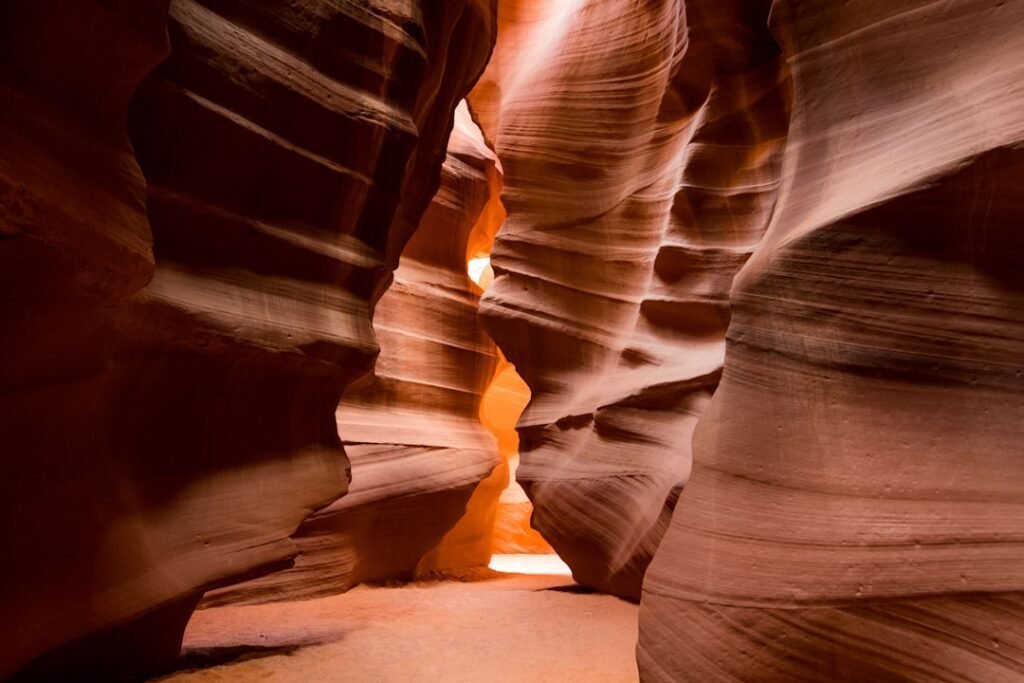
The canyon is carved into Navajo Sandstone, a rock layer that formed roughly 190 million years ago when this part of the Southwest was a vast desert of shifting sand dunes. Over time those dunes were buried, compressed, and cemented into rock by minerals like iron oxide, which is exactly what gives the walls their warm color palette. That iron-rich sandstone is also relatively soft, which turns out to be the key ingredient in the canyon’s formation.
The main force behind the carving is flash flooding. When monsoon rains hit the Colorado Plateau, water rushes off the hardpan desert surface and funnels into low-lying cracks in the rock. The water moves fast, carrying sand and sediment, and that abrasive slurry grinds against the sandstone walls with enormous pressure. Over thousands of years, the rushing water wore away the rock from the inside, cutting downward and outward in a process called slot canyon formation. The smooth, swirling texture you see on the walls today is a direct record of that water movement, a kind of slow-motion erosion frozen in stone.
Wind erosion played a secondary role, smoothing out the finer details once the water had done the heavy lifting. The result is a canyon that looks polished and almost architectural, even though every curve was made entirely by natural forces.
Upper vs. Lower Antelope Canyon: Same Process, Different Experience
Antelope Canyon is actually two separate slot canyons that formed through the same process but offer very different visits. Upper Antelope Canyon, known to the Navajo as Tsé bighánílíní or “the place where water runs through rocks,” is the one famous for its dramatic light beams. It sits at ground level, making it easy to walk through without much climbing. Lower Antelope Canyon, called Hazdistazí or “spiral rock arches,” requires descending a series of metal staircases into the earth. Its passages are narrower and tend to be less crowded, giving visitors a more raw, unfiltered look at the geology.
Both sections continue to change slowly over time. Flash floods still move through the canyon during Arizona monsoon season, typically July through September, and each one reshapes the walls slightly. Visiting in spring or fall means calmer conditions and good light without the flood risk.
If you are planning a trip from Las Vegas, the canyon is about a four-and-a-half-hour drive and pairs naturally with Horseshoe Bend. A guided tour makes the logistics straightforward and gets you access to the Navajo-permitted entry that is required for all visitors. The Lower Antelope Canyon and Horseshoe Bend Day Tour covers both in a single long day, while the Antelope Canyon Guided Tour from Las Vegas gives you a broader look at two of the Southwest’s most photographed spots. Photographers with specific goals may want to look at the Antelope Canyon Night Photography Tour, which opens up the canyon for star shooting after dark, a completely different side of the same remarkable geology.
Understanding how Antelope Canyon formed makes standing inside it feel even more significant. Those walls have been shaped by forces that predate human civilization by orders of magnitude, and they are still being shaped today.